
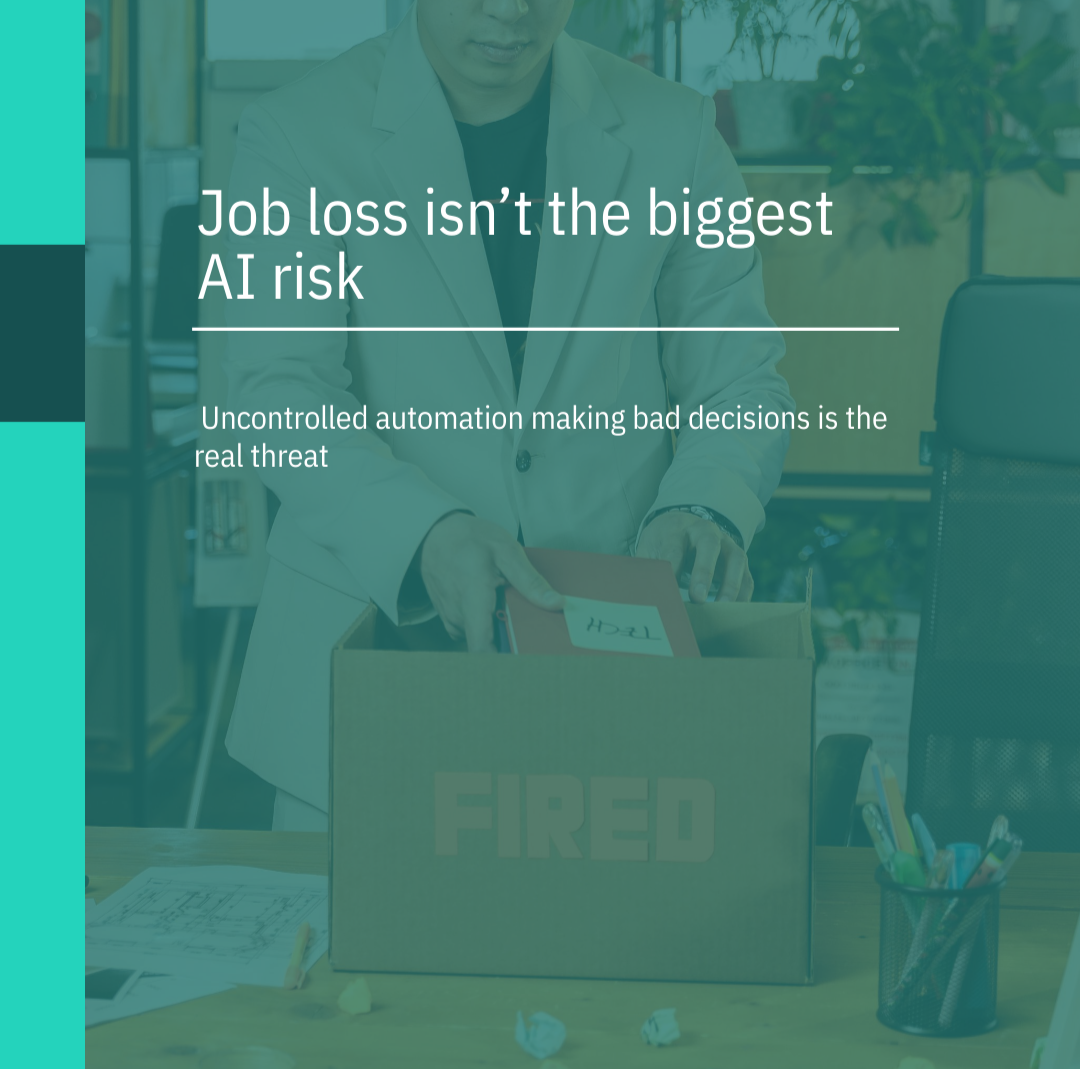
Job Loss Isn’t the Real AI Risk

It’s uncontrolled decision-making.
The real issue isn’t just job loss.
It’s uncontrolled automation, where organizations quietly let AI decide things it should only support. That’s where the biggest operational, legal, and reputational failures are already happening.
And it’s creating a quiet crisis. Organizations are relying on incorrect AI data. And they often skip human oversight for AI decisions that affect real people. When automation becomes the decision maker, it’s not the AI that’s out of control, but rather the lack of oversight.
Human-in-the-Loop Oversight Isn’t Optional
AI is being used as a “decision maker” without decision governance. And that’s an issue.
Many organizations don’t formally define:
- What the AI is allowed to do
- What a human must approve
- What the AI must never do
- Who is accountable when it’s wrong
So AI gets deployed like an “employee”, but without:
- Training standards
- Supervision
- Escalation paths
- Performance management
- Auditability
Organizations publish incorrect outputs and call it “reporting”
AI is not a “source”. It’s at best a draft generator, but organizations are using AI output as evidence. And here’s exactly how failures happen:
- AI generates something plausible
- People treat it as correct
- It gets reused downstream as “truth”
- The organisation publishes it
And it’s happening across many departments all over in organizations, including:
- Compliance reports
- Risk summaries
- Incident write-ups
- Customer communications
- Financial / KPI narrative reporting
- Policy documentation
Automated decision-making becomes dangerous fast
AI decisions cause harm when they impact rights, access, or outcomes, such as:
- Hiring/firing
- Credit/lending
- Insurance
- Healthcare prioritization
- Fraud detection “blacklists”
- Benefit eligibility
And AI can create irreversible downstream actions, especially when unchecked AI-decisions compound on top of each other. One flawed rule can operate at scale, impacting thousands of decisions and actions before it’s detected, such as:
- Account closure
- Denial of service
- Disciplinary action
- Investigations
- Reporting to authorities
We need realignment of responsibility boundaries
Organizations need explicit limits on what AI does. One simple and effective model is to split AI usage into 3 categories: low, medium, and high.
- Low-risk activities require advisory-level support, and the rule should always be that humans remain the decision makers.
- Summarizing
- Drafting content
- Suggesting options
- Identifying patterns
- Medium-risk activities also require human decision-making with an added layer of mandatory human approval with documented explainability and logs.
- Ranking/scoring
- Prioritization suggestions
- Risk flags
- High-risk activities must be treated like a regulated automated system with strict controls.
- Approve/deny decisions
- Disciplinary actions
- Customer impact decisions
- Regulatory reporting decisions
When AI quietly becomes a shadow decision engine
It’s easy for organizations of any size to still publish wrong “automated decisions” when they are using AI without proper oversight. They use AI to make informal decisions, and those errors become institutionalized because they don’t have:
- An effective risk model that can be understood
- A governance model linked to a control framework for AI decision-making
- “Human in the loop” requirements
- Audit trails
- Validation tests
- Accountability ownership
Why AI “gets out of control” and how to regain control
AI isn’t evil. It’s just frequently unmanaged because it’s connected to workflows without oversight. It’s allowed to trigger actions automatically without a human monitoring the output.
People stop checking because “it’s usually fine.” This is exactly how automation failures have always happened. AI just increases the scale and believability of bad output.
You need effective controls that work. Here’s what separates safe AI use from chaos:
- Governance & accountability
- Named AI System Owner
- Named Decision Owner
- Named Model Risk Owner
- Decision controls
- Decision boundaries written (allowed/prohibited)
- Human approval points for high-risk outputs
- Mandatory justification for overrides
- Monitoring & validation
- Sampling reviews (weekly/monthly)
- Accuracy tracking + incident logging
- Drift monitoring (data, behavior, output quality)
- Traceability
- Output logs
- Prompt/version control
- Evidence linking (“what sources support this output?”)
- Restrictions by impact level
- Higher impact = higher review + stricter limits
- No exceptions “because we were busy”
A blunt truth: AI risk is a leadership accountability problem
The organizations that fail will say, “The AI made a mistake.” But that’s not a valid operational explanation.
The organisation made the mistake by allowing AI to act without governance.
Need help navigating your AI risk
Getin touch. We'd love to help.
Questions about risk, ISO, compliance, or AI?


.png)
.png)